
What Actually Happens During a Septic Pumping Appointment
What happens during a septic pumping visit in Clarksville, TN: timing, process and what to ask the crew. Call to schedule yours.
Published by Clarksville Septic & Drainfield, serving Clarksville and Montgomery County, Tennessee. Questions about your own system? (931) 271-5114.
If you have never had a septic tank pumped, the whole thing is opaque: you do not know how long it takes, whether you need to be home, what they will do to the lawn, or what a reasonable outcome looks like. Here is the whole process.
Before the visit
Know where the tank is, if you can
This is the one thing that changes the price. If the lid is at grade or you can point at it, the crew starts work immediately. If it is buried, it has to be located and excavated, which adds roughly $150 to $250. If nobody knows where the tank is at all, a locate comes first.
Worth checking beforehand: the direction the main line leaves the house, any permit record from the state, and any rectangle in the lawn that greens or dries differently from the rest.
Clear access for the truck
A vacuum truck is a large vehicle with a hose reach of typically 100 to 150 feet. It needs to get reasonably close. Move cars, unlock gates, and mention anything awkward when you book: a steep drive, a soft yard after rain, a narrow gate, a low branch.
Do not pump first, if this is an inspection
If the visit is diagnostic rather than routine, let them look before they empty it. The liquid level and the sludge depth are the two most informative things available and both disappear the moment the hose starts.
During the visit
A routine pump-out on an accessible tank takes thirty minutes to an hour. Add time for excavation if the lid is buried, and for a larger or badly neglected tank.
The sequence is consistent:
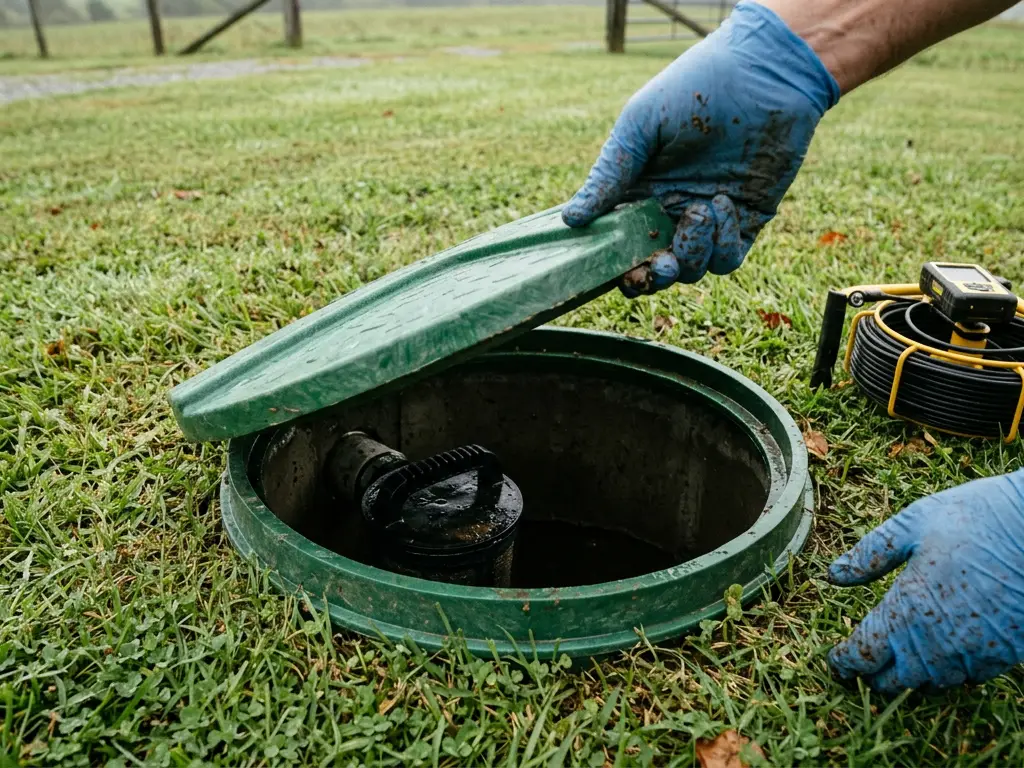
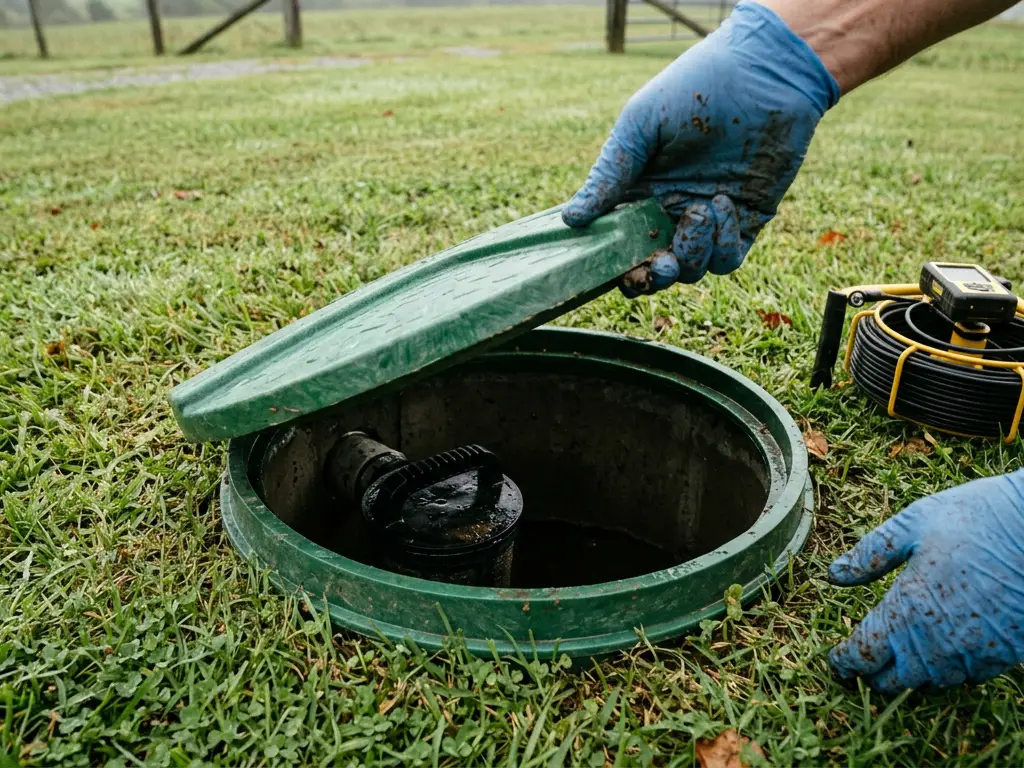
- The lid comes off. On a two-compartment tank there are usually two access points.
- The level is checked. Where the liquid sits relative to the outlet is the free diagnostic. Level at or above the outlet on a tank that was pumped recently means the drainfield is not accepting water.
- The tank is pumped. Liquid first, then the sludge layer off the bottom. On a tank in normal service most of it lifts readily.
- Back-flushing if needed. On a compacted layer, liquid gets returned under pressure to break things up. If this turns into a substantial job, you are into cleaning rather than pumping and the price differs.
- Components get checked. Inlet and outlet baffles, the effluent filter if fitted, the condition of the walls and the lid. An empty tank is the only time any of this is visible.
- The filter is cleaned. Usually included. Ask if it is not mentioned.
- The lid goes back. Properly seated and secured.
You do not need to be home for a routine pump-out on an accessible tank, though you will get more out of it if you are, because the useful information is verbal and arrives while they are standing over the open tank.
What they should tell you afterwards
- The liquid level before pumping started, relative to the outlet
- Approximate sludge depth, which sets your next interval
- Tank size and material
- Condition of the baffles, and whether the filter was fouled
- Anything visibly wrong: cracks, spalling, a lid that is no longer safe
- Where the septage is going
That last one is not pedantry. Septage is regulated waste in Tennessee and has to be hauled by someone holding a current pumper permit and taken to an approved facility. Montgomery County is not one of the nine contract counties, so those permits sit with the state and are published. A legitimate operator answers this question without hesitating.
Questions worth asking while they are there
- What was the level before you started?
- How deep was the sludge, and when should I do this again?
- Are the baffles intact?
- Could you fit risers so I stop paying to dig?
- Is there anything about the field I should be worried about?
Question four is the one that pays for itself. If the lid was buried, fitting risers during a visit where the hole is already open runs $300 to $600 on top of the pumping, against $400 to $1,100 as a separate job, and it ends the excavation charge permanently.
What the yard will look like
On an accessible tank, almost nothing: a lid lifted and replaced.
If excavation was needed, expect a hole roughly two to three feet across over each access point, backfilled and tamped. The grass above it will be disturbed and will take a few weeks to recover. Truck tracks on soft ground are normal after rain.
Nothing should be dug over the drainfield itself, and nothing should be driven across it.
Common outcomes and what they mean
Routine, nothing found. The expected result. Note the date and the sludge depth and set the next interval.
Tank would not empty fully. A compacted layer the vacuum could not lift. Book a proper cleaning rather than treating this as done.
Level was already high. The field is struggling. This is the early warning worth acting on, and it is much cheaper now than after effluent surfaces.
Baffle missing or crumbled. A few hundred dollars to fix and genuinely urgent, because a failed outlet baffle sends solids to the field continuously with no symptom in the house.
Filter caked. Normal if it is overdue. If it fouls again within weeks, something upstream needs looking at.
Afterwards
Use water normally. The tank refills with liquid within a day or two and that is exactly what should happen. Do not add anything to restart the bacteria, because ordinary household wastewater does that on its own within days.
Write down the date, the sludge depth and the tank measurements, and keep it with the property paperwork. On a septic property across the areas we cover, that single note is worth more at resale than most people expect, and it makes every future visit cheaper.
Questions about your own system? Talk it through on the phone.
Call (931) 271-5114Questions people ask about this
How long does septic tank pumping take?
Thirty minutes to an hour for a routine pump-out on an accessible tank. Add time if the lid has to be located and excavated, and for larger or badly neglected tanks that need back-flushing.
Do I need to be home when the septic tank is pumped?
Not for a routine pump-out on an accessible tank. You will get more out of it if you are, because the useful diagnostic information is verbal and arrives while the crew is standing over the open tank.
Will they dig up my yard?
Only if the lid is buried, and then only a hole two to three feet across over each access point, backfilled afterwards. Nothing should be dug over the drainfield. Fitting risers during the visit means it never needs digging again.
What should I ask the crew while they are there?
What the liquid level was before pumping, how deep the sludge was, whether the baffles are intact, and whether risers can be fitted. The level before pumping is the best free information you will get about your drainfield.
Need this done rather than explained?
Septic Tank Pumping in Clarksville, with a written price before anyone starts work.