Clarksville Septic & Drainfield: Septic Service in Clarksville, TN
Pumping, drainfield work, installation and inspections across Clarksville and Montgomery County. Straight answers and a written price before anyone starts.
- Clarksville and Montgomery County
- Written price before work starts
- We work with licensed, insured local contractors
- Pump-outs, drainfields, installs and inspections
- Straight answers about what your system needs
Clarksville Septic & Drainfield connects homeowners and property managers across Clarksville and Montgomery County, Tennessee with septic crews who pump tanks, repair and replace drainfields, install new systems and carry out inspections. Most of the septic load in this county sits outside the city sewer envelope: the rural west and south toward Woodlawn and Southside, the southeastern corridor through Sango toward the Cumberland, and the older stock along the Red River. If your property is on a tank, this is the work that keeps it out of your yard and out of your house.
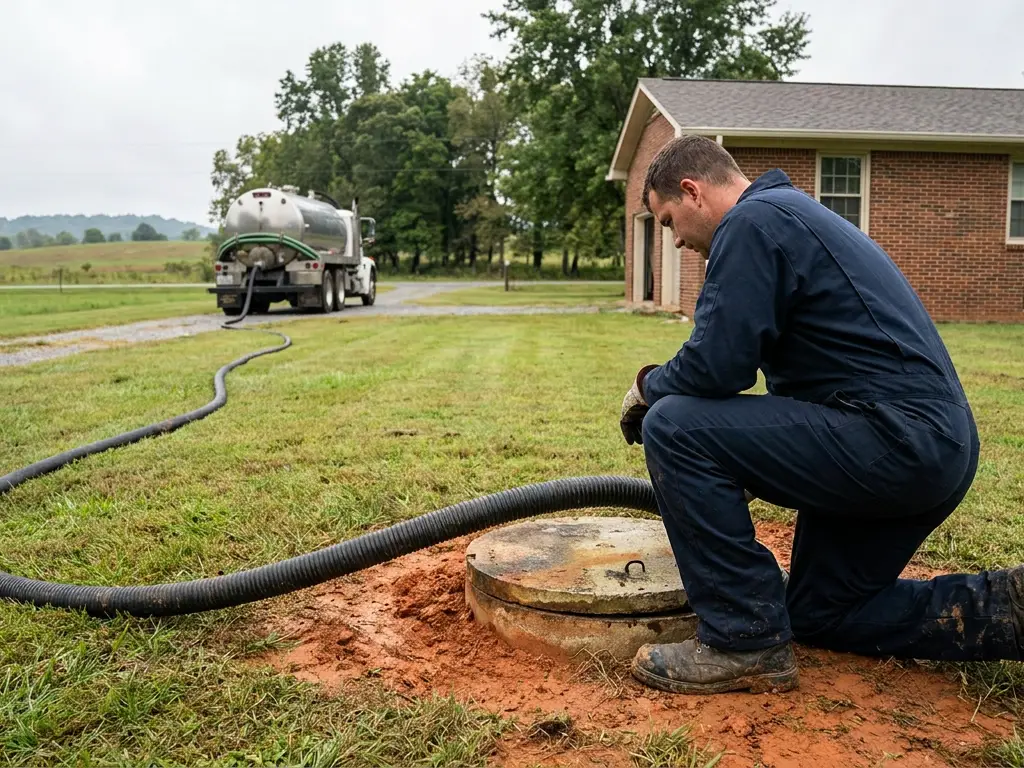
The tank is the part you can service. The drainfield is the part you cannot, and almost every failed drainfield in this county failed because solids reached it from a tank nobody emptied. That relationship is worth understanding before you spend anything.
Wait until solids migrate out of the tank and a $450 pump-out becomes a $9,000 to $18,000 drainfield replacement.
What we cover
Septic Tank Pumping
$375 to $700 for a standard 1,000 gallon residential pump-out.
Septic Tank Cleaning
$475 to $900 for a residential clean out with wall wash-down.
Septic System Installation
$8,500 to $15,000 for a conventional gravity system, three bedroom, good soil.
Septic Tank Repair
$350 to $700 for a inlet or outlet baffle or tee replacement.
Drainfield Repair
$1,200 to $2,800 for a distribution box repair or replacement.
Drainfield Replacement
$9,000 to $18,000 for a conventional gravity field replacement in a clear reserve area.
Septic Inspection
$250 to $450 for a visual inspection, tank opened and components checked.
Emergency Septic Service
$450 to $900 for a emergency pump-out, standard residential tank.
Septic System Maintenance
$150 to $300 for a effluent filter clean and system check, tank accessible.
Septic Tank Replacement
$3,500 to $6,500 for a 1,000 gallon concrete tank, straightforward access.
Real Estate Septic Inspection
$450 to $850 for a full inspection with hydraulic field loading.
Tell us what the system is doing and we will tell you what it usually means.
Call (931) 271-5114What you are probably seeing right now
Septic systems fail slowly and then suddenly. These are the things people describe on the phone in the weeks before a backup, in the order they usually turn up.
- Drains slowing across the whole house at once, not one fixture
- Gurgling from a toilet or tub when the washing machine drains
- Sewage smell outdoors, strongest over the tank or the field
- Grass over the drainfield greener and growing faster than the rest of the yard
- Soft or wet ground over the field during a dry week
- Backups that clear for a day or two and then return
- Problems that only appear after heavy rain
That last one is worth separating out. A system that only misbehaves after rain is usually taking in groundwater, either through a cracked tank or through a field saturating from below. It often gets diagnosed as field failure and treated with a replacement quote when the actual fix is sealing the tank. Ask for that to be ruled out first.
What septic work costs around Clarksville
These are the ranges that come up most often locally. They are ranges because tank size, depth, access, soil and the age of the system all move the number.
Standard residential pump-out: $375 to $700
Tank cleaning, neglected system: $475 to $1,300
Drainfield repair: $1,200 to $9,000
Drainfield replacement: $9,000 to $18,000
New conventional system, three bedroom: $8,500 to $15,000
Ranges, not quotes. Call (931) 271-5114 and you get a written price before work starts.
Septic in Montgomery County, specifically
Who regulates it
Onsite wastewater in Tennessee is regulated by the Tennessee Department of Environment and Conservation, Division of Water Resources. Installers are permitted under Rule 0400-48-01-.19 and pumpers under Rule 0400-48-01-.20, and those are separate permits: a company permitted to install a system is not automatically permitted to pump one. Permits are issued statewide and expire on 31 December each year. Montgomery County is not one of the nine contract counties that administer their own programs, so the state handles this county directly. Every permitted installer in Tennessee carries the Conventional class, and the alternative classes that exist, Low Pressure Pipe, Mound, Drip and Oxidation Lagoon, are additive on top of it rather than a substitute for it.
The ground here
Montgomery County sits on the Highland Rim. Limestone lies at variable depth under a silty clay loam that percolates slowly, and in places that limestone is karst, with sinkholes and solution channels that carry water straight to groundwater without the soil treatment a septic system depends on. The practical effect for homeowners is two-fold: drainfields here are often sized larger than the same house would need on sandier ground, and a perched water table forms above the clay horizon through late winter and spring, loading fields from below regardless of what the household is doing. That is why so many local failures appear in February and March and seem to resolve by July.
Where the tanks are
Clarksville's sewer system covers the city core and most newer subdivisions inside it. Everything else is on septic. The heaviest concentrations are the southeastern corridor through Sango, the western and southern rural areas around Woodlawn, Southside, Palmyra and Cunningham, and the older properties along the Red River toward Port Royal. Housing around Fort Campbell turns over frequently with military rotations, which means a high share of those tanks change hands with no service history attached at all.
If it is backing up right now
Stop running water. Every flush and every load of laundry goes into a system that has already run out of room. Keep people and pets off anything surfacing outside, because it is untreated wastewater. Then call. A pump-out usually gets the house usable within the hour.
Septic questions people in Clarksville ask
How often does a septic tank need pumping in Clarksville?
Every three to five years for most households. Family size, a garbage disposal and tank size all move that. The only way to know where you are in the cycle is to open the lid and measure the sludge depth, which is done at the pump-out.
How much does septic service cost in Clarksville, TN?
A standard residential pump-out runs $375 to $700. Drainfield repair runs $1,200 to $9,000 depending on what failed. A full drainfield replacement runs $9,000 to $18,000, and a new system for a three bedroom house runs $8,500 to $15,000 on suitable soil.
Who regulates septic systems in Montgomery County?
The Tennessee Department of Environment and Conservation, Division of Water Resources. Montgomery County is not one of the nine contract counties that run their own programs, so the state administers here directly rather than a county health department.
What are the first signs a septic system is failing?
Drains slowing across the whole house at once rather than one fixture, gurgling when the washing machine drains, a sewage smell outdoors, and grass over the drainfield that is greener and growing faster than the rest of the yard. Wet ground over the field in dry weather is the clearest one.
Do I need a septic inspection when buying a house here?
Tennessee has no time-of-transfer inspection law, so nothing requires it automatically. On a septic property it is worth asking for anyway, because otherwise nothing in the transaction looks at the system. Ask for a full inspection that loads the field, not just a visual.
Is there anything I should never put down a septic drain?
Wipes of any kind including the ones sold as flushable, grease, coffee grounds, cat litter, paint and solvents. Also go easy on bleach in volume. None of these break down in a tank and most of them end up in the drainfield, which is the part you cannot replace cheaply.