Clarksville Septic & Drainfield: Septic System Installation in Clarksville, TN
New septic system installation in Clarksville, TN. Conventional and alternative systems, $8,500 to $32,000. Call to plan yours.
- Serving Clarksville and Montgomery County
- Written price before work starts
- We work with licensed, insured local contractors
- Straight answers about what your system needs
Clarksville Septic & Drainfield puts Montgomery County property owners in touch with installers who design and build new onsite wastewater systems, whether that is a conventional gravity field for a new build on good ground or an alternative design for a lot that will not take one. Installation is the one part of septic work that starts with the soil rather than the house. A soil scientist evaluates the site, the state reviews the proposed design against what that soil will actually accept, and only then does anyone specify a tank size or a field layout. Skipping that order is how properties end up with a system that was never going to work.
Installing on an unevaluated site risks a field that fails inside five years, turning a $14,000 system into that plus a $9,000 to $18,000 replacement.
The soil decides the system, not the budget
Two neighbouring lots on the Highland Rim can require completely different systems. Shallow soil over limestone, a seasonal water table, or a restrictive clay horizon at eighteen inches each rule out a conventional gravity field and push the design toward low pressure pipe, a mound, or drip dispersal. Those designs cost substantially more and they exist because the cheaper option would fail. An installer who quotes a conventional system before the soil evaluation is done is quoting a number, not a system, and the revision that follows is rarely in your favour.
Sizing is driven by bedrooms, not by occupancy
Design flow is calculated from the number of bedrooms the house has, because bedrooms are what the next owner will fill. A three bedroom house is designed for a load that a couple living alone will never generate, and that headroom is deliberate. It also means adding a bedroom later is a system question before it is a construction question: the existing field may not carry the increased design flow, and the addition may require an expanded field before it can be permitted.
Placement constrains the rest of the property forever
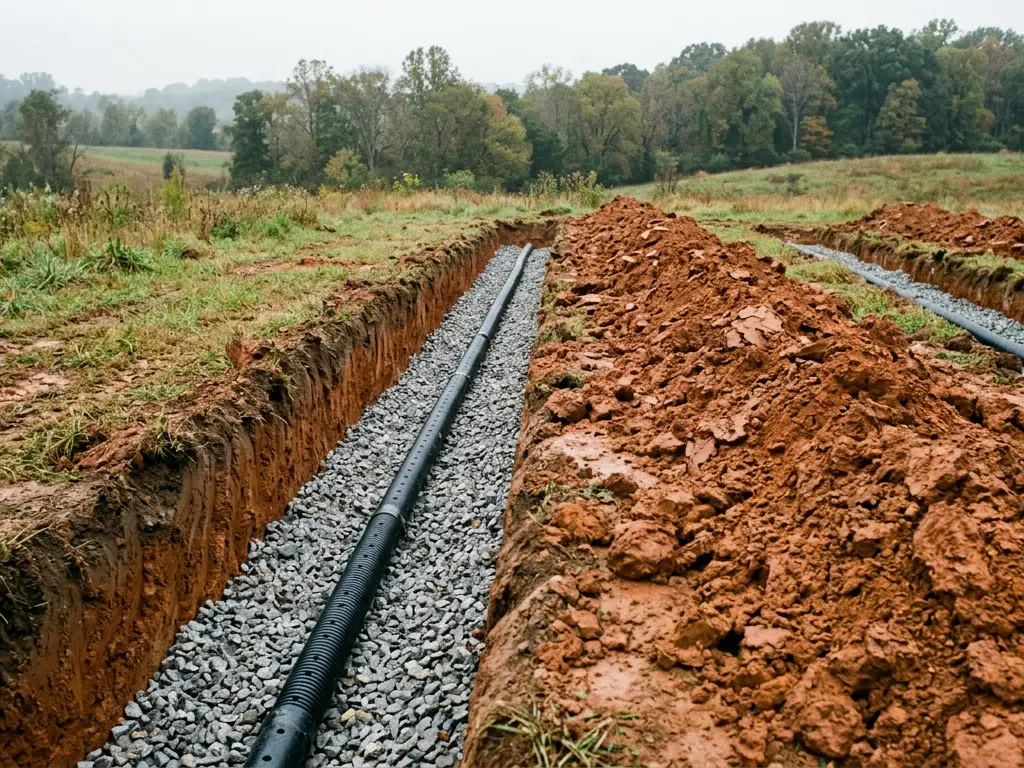
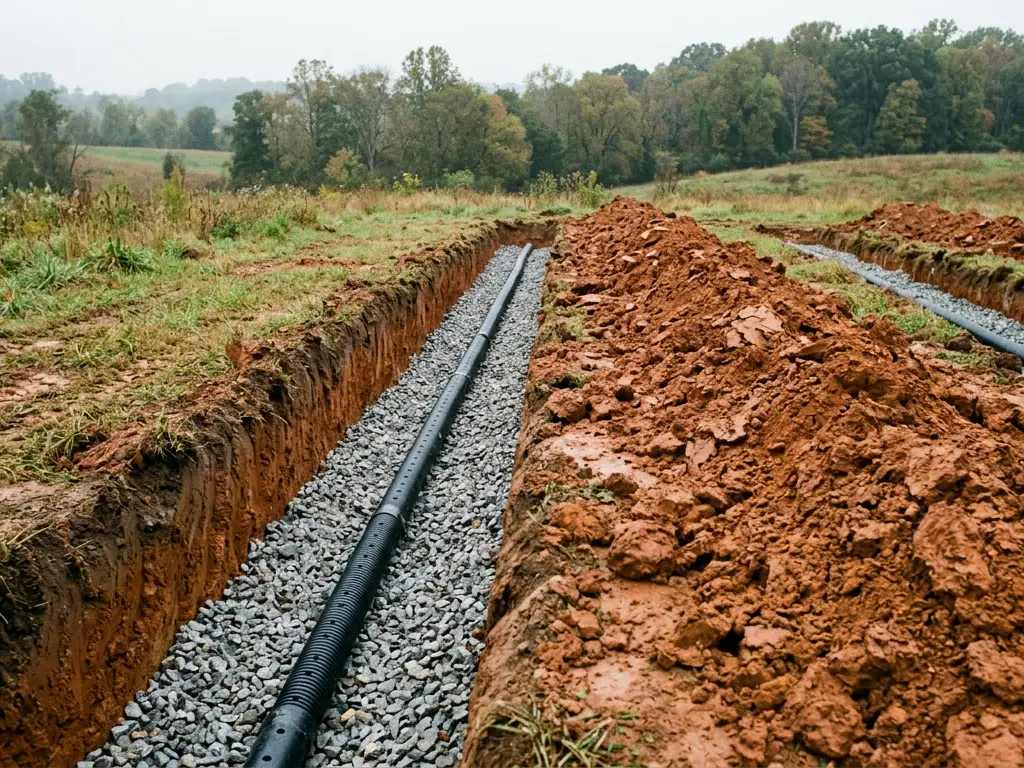
A drainfield cannot be driven on, built over, paved, or planted with anything that roots aggressively, and it needs a reserve area set aside for the eventual replacement. Deciding where the field goes is therefore a decision about where the shop, the pool, the driveway extension and the future addition cannot go. Getting that layout right at installation, with the reserve area recorded, is worth more over thirty years of owning the property than any component choice made on the same day.
Not sure which service you need? Talk it through on the phone.
Call (931) 271-5114What septic system installation costs in Clarksville
Installation cost is driven by soil, slope, system type and how far the field sits from the house. Typical ranges in this county:
Conventional gravity system, three bedroom, good soil: $8,500 to $15,000
Low pressure pipe or pump-to-field system: $14,000 to $24,000
Mound or drip dispersal on restrictive soil: $20,000 to $32,000
These are ranges, not quotes. Call (931) 271-5114 and you get a written price before anyone starts work.
How this works in Montgomery County
Permits and who regulates this
Subsurface sewage disposal systems in Tennessee are permitted by TDEC's Division of Water Resources under Rule 0400-48-01-.19, and Montgomery County is not a contract county, so the state handles review here directly rather than a county health department. Installers hold permits by class. Every permitted installer in the state carries the Conventional class, and the alternative classes are additive on top of it rather than a substitute: the state's own registry shows no installer holding an alternative class without Conventional. The alternative classes that exist are Low Pressure Pipe, Mound, Drip and Oxidation Lagoon, and an installer who will be building a drip system should hold that class. Ask which classes a contractor holds and check it against the state's published list before work starts.
Soil, water table and what the ground here does
Montgomery County's position on the Highland Rim means limestone at variable depth and a real risk of karst features on a given lot. Sinkholes and solution channels are disqualifying for a drainfield because they short-circuit the soil treatment the system depends on, sending effluent to groundwater without filtration. The silty clay loam above the rock percolates slowly, so fields here are often sized larger than the same house would need on sandier ground, and wet-season water tables push more designs toward low pressure pipe than a first-time buyer expects.
Where the septic properties are
New residential construction in the county has pushed hardest into Sango and the southeast toward the Cumberland, and northwest along the Fort Campbell corridor. Those are the areas generating most new system permits. Lots being split out of larger rural parcels near Woodlawn and Southside are where soil surprises turn up most often, because the original farmhouse was sited on the best ground on the tract and the new lot gets what is left.
If it is backing up right now
Stop running water, keep people and pets away from anything surfacing outside, and call. A pump-out will usually get the house usable within the hour.
Septic System Installation questions we get asked
How much does a new septic system cost in Clarksville, TN?
A conventional gravity system for a three bedroom house on suitable soil generally runs $8,500 to $15,000. Low pressure pipe or a system needing a pump to reach the field runs $14,000 to $24,000. Mound and drip systems on restrictive soil run $20,000 to $32,000. Soil and slope drive the number more than anything else.
What has to happen before a system can be installed?
A soil evaluation on the actual lot comes first, then a system design based on what that soil will accept and on the number of bedrooms, then state review and a construction permit. Installation follows. The sequence is not optional and the soil result can change the design and the price substantially.
How long does installation take?
The physical work on a conventional system is usually two to four days once the equipment is on site. The permitting and soil evaluation ahead of it are what set the real timeline, and that can run several weeks depending on scheduling and on whether the first design is approved.
How is system size determined?
By the number of bedrooms in the house, which is the standard proxy for design flow, combined with the soil loading rate from the site evaluation. Occupancy is not used, because the design has to serve whoever lives there next.
Can I build over part of the drainfield later?
No. The field needs the soil above it for oxygen transfer and evaporation, and compaction from vehicles or structures destroys it. A reserve area for the eventual replacement field also has to stay clear. Plan driveways, shops and additions around both before you install.
What is an alternative system and will I need one?
It is a design used where a conventional gravity field will not work: low pressure pipe, mound, or drip dispersal. You need one when the soil evaluation finds shallow depth to rock, a seasonal water table, or a restrictive layer. The soil result decides it, not preference.
Related work
Septic Tank Pumping
Pricing varies with tank size, depth, access and how long it has been since the last service.
Septic Tank Cleaning
Cleaning costs more than pumping because it takes longer and removes more material.
Septic Tank Repair
Component repairs are priced by the part and the access needed.