
What Septic Tank Pumping Costs in Tennessee, and What Moves the Price
What septic pumping, repairs and drainfield work cost around Clarksville, TN, and what moves a quote. Call for a price on your own system.
Published by Clarksville Septic & Drainfield, serving Clarksville and Montgomery County, Tennessee. Questions about your own system? (931) 271-5114.
Nobody publishes septic prices, which is why everybody calls three companies and still has no idea whether the number they were given is reasonable. This is what the work actually costs around Clarksville and Middle Tennessee, what makes a quote go up, and which of those factors you can do something about.
Every figure here is a range. Septic pricing genuinely varies with tank size, depth, access and the state of the system, and any company quoting a flat number sight unseen is either guessing or planning to revise it.
Pumping and cleaning
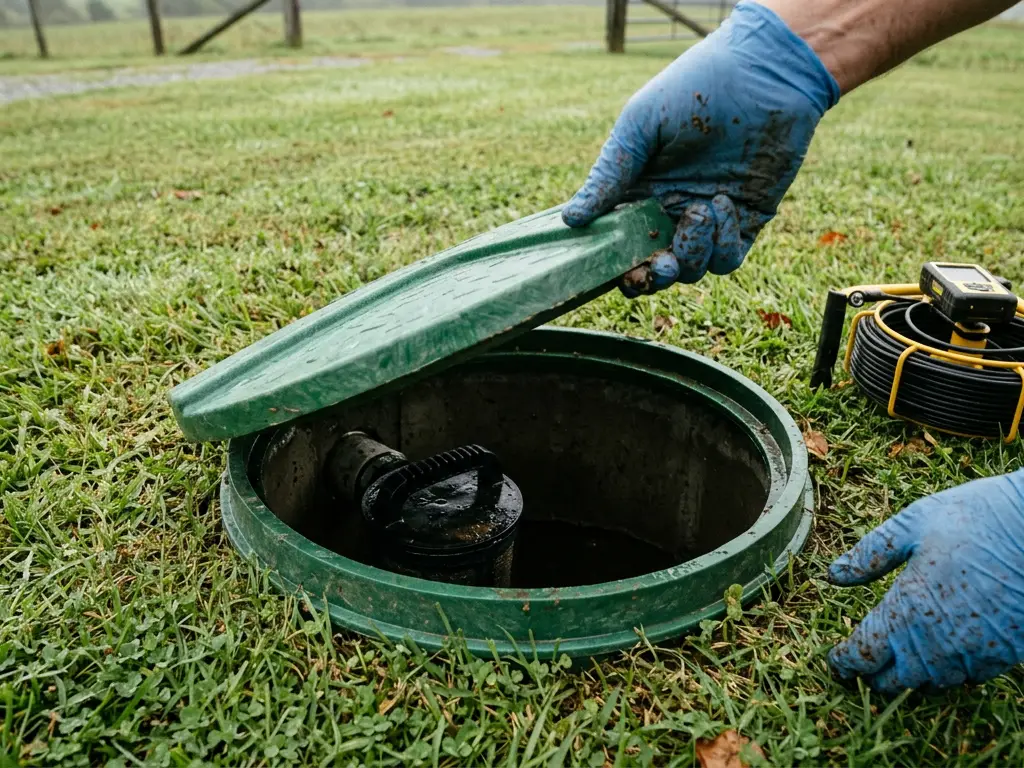
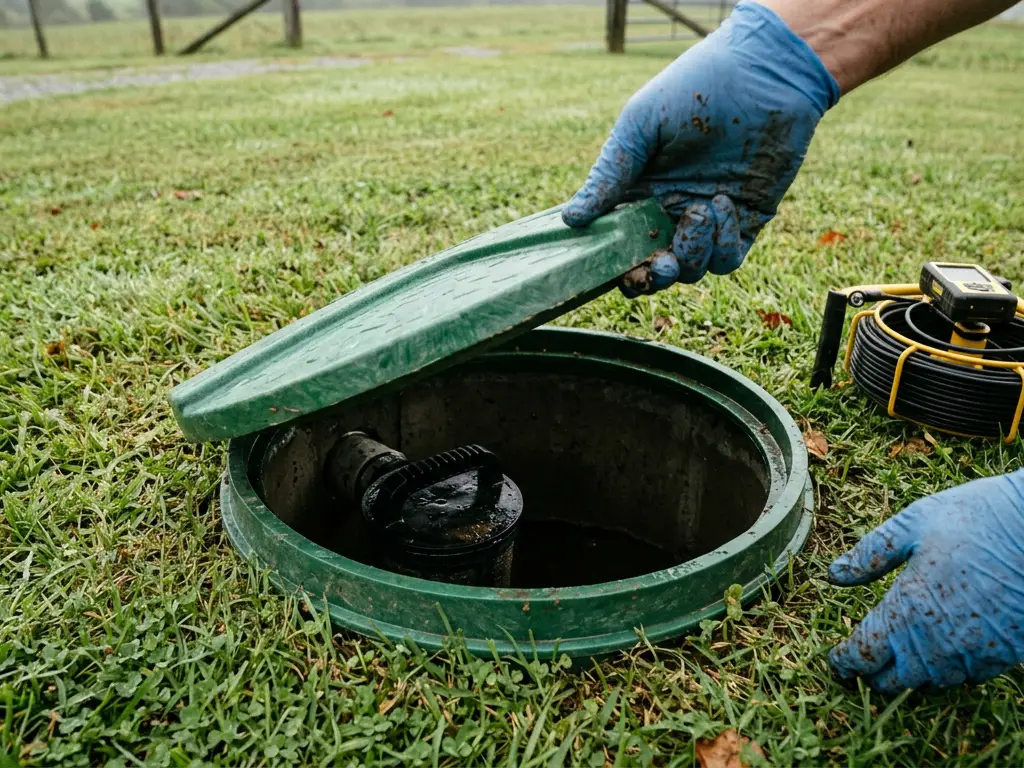
A standard 1,000 gallon residential pump-out runs $375 to $700 in this area. That covers arriving, opening an accessible lid, vacuuming out the liquid and sludge, and hauling it to an approved disposal site.
Two things push it up immediately. If the lid is buried, somebody has to find and excavate it, which adds roughly $150 to $250. If the tank is larger, a 1,500 gallon tank or a commercial tank carrying grease, expect $700 to $1,400.
Tank cleaning is a different service and costs more, $475 to $1,300. Cleaning means the walls are washed down and hardened material is broken loose and removed, rather than just vacuuming off what will lift. On a tank that has gone eight or ten years, a straight pump-out will leave a compacted layer behind and you will have paid for a job that was only half done.
A $450 pump-out on schedule is the cheapest insurance in home ownership: neglect it and solids reach the drainfield, turning it into a $9,000 to $18,000 replacement.
Inspections
- Visual inspection, tank opened and components checked: $250 to $450
- Full inspection with hydraulic loading of the drainfield: $450 to $850
- Inspection combined with a pump-out: $650 to $1,300
The gap between the first two matters more than the money. A visual inspection does not test the drainfield, and the drainfield is the component worth five figures. On a house purchase, order the full one.
Repairs
Component repairs are the cheap end of septic work and they are where the money is best spent, because almost all of them protect the drainfield.
- Inlet or outlet baffle replacement: $350 to $700
- Lid replacement or a riser fitted to grade: $400 to $1,100
- Effluent filter cleaning: $150 to $300, usually free during a pump-out
- Crack sealing or structural tank repair: $900 to $4,500
- Clearing a blocked line between house and tank: $400 to $1,100
- Excavating and replacing a collapsed line section: $1,500 to $4,500
Drainfields
This is where septic gets expensive, and the numbers are worth knowing before you need them.
- Distribution box repair or replacement: $1,200 to $2,800
- Line jetting and root clearing: $1,400 to $3,200
- Partial field rebuild, one or two laterals: $3,500 to $9,000
- Full conventional field replacement: $9,000 to $18,000
- Replacement needing a pump and low pressure pipe: $15,000 to $24,000
- Mound or drip system where no conventional site remains: $20,000 to $28,000
New systems
A complete new system for a three bedroom house on suitable soil runs $8,500 to $15,000. Low pressure pipe or a design needing a pump to reach the field runs $14,000 to $24,000. Mound and drip systems on restrictive soil run $20,000 to $32,000.
Before any of that, the soil evaluation runs $450 to $900, or $900 to $1,600 with a design and submission. That is not an optional preliminary. It determines which of the three bands above you are in, and nobody can quote honestly without it.
What actually moves the price
Access
The single most controllable factor. A tank with risers at grade is a lift-and-pump. A buried lid is an excavation, billed every time. An unknown tank location is a search, billed on top of that. Fitting risers once ends all of it.
Tank size and how long it has been
A larger tank holds more and costs more to empty. A tank that has gone a decade may need cleaning rather than pumping, which is a different price. Neither is avoidable once you are there, but both are avoidable with a schedule.
Soil, on anything involving the ground
Montgomery County sits on the Highland Rim: silty clay loam over limestone that sits at variable depth, and in places is karst. Slow percolation means fields here are often sized larger than the same house would need elsewhere, and shallow rock or a seasonal water table can rule out a conventional design entirely. That geology is the difference between a $12,000 field and a $26,000 one, and it is decided by the soil evaluation rather than by anything you choose. Where your property sits in the county affects this, and the areas we cover vary considerably in what the ground does.
Emergency versus scheduled
An after hours or weekend callout carries a premium, typically $600 to $1,200 against $450 to $900 for the same pump-out during the week. Almost every septic emergency was a maintenance item six months earlier.
Where the money is best spent
If you read one section, read this one. The cost structure of septic work is unusually lopsided: the maintenance is cheap, the failure is expensive, and they are directly connected.
The tank is the serviceable part. The drainfield is not. Every dollar spent keeping solids inside the tank, scheduled pumping, a working effluent filter, intact baffles, is a dollar spent protecting the component that costs five figures to replace. Almost every failed drainfield in this county failed because that did not happen.
What a fair quote looks like
- A range or a written price, not a verbal number that changes on the day
- A clear statement of what is and is not included, particularly lid excavation
- The permit status of the company doing the work, which Tennessee publishes and you can check
- Where the septage is going, which a permitted hauler can tell you
- No pressure to authorise drainfield work on the same visit as a first diagnosis
That last point is worth holding onto. A drainfield quote given before anyone has ruled out a failed baffle, a settled distribution box or a cracked tank admitting groundwater is a quote for the most expensive possible explanation.
Questions about your own system? Talk it through on the phone.
Call (931) 271-5114Questions people ask about this
How much does it cost to pump a septic tank in Tennessee?
A standard 1,000 gallon residential pump-out runs $375 to $700 around Clarksville. Add $150 to $250 if the lid is buried and has to be located and dug out. Larger and commercial tanks run $700 to $1,400.
Why do septic quotes vary so much?
Tank size, depth, access, how long it has been since the last service, and whether the job needs cleaning rather than pumping. A buried lid alone can move a quote by a couple of hundred dollars before anyone touches the tank.
How much does a new drainfield cost?
A conventional field replacement runs $9,000 to $18,000. If the design needs a pump and low pressure pipe it runs $15,000 to $24,000. Mound and drip systems, used where no conventional site remains, run $20,000 to $28,000.
Is it cheaper to pump more often or wait?
Pumping on schedule is dramatically cheaper. The whole cost structure of septic is that a few hundred dollars every few years protects a component that costs five figures. Waiting does not save money, it defers a much larger bill.
Need this done rather than explained?
Septic Tank Pumping in Clarksville, with a written price before anyone starts work.