
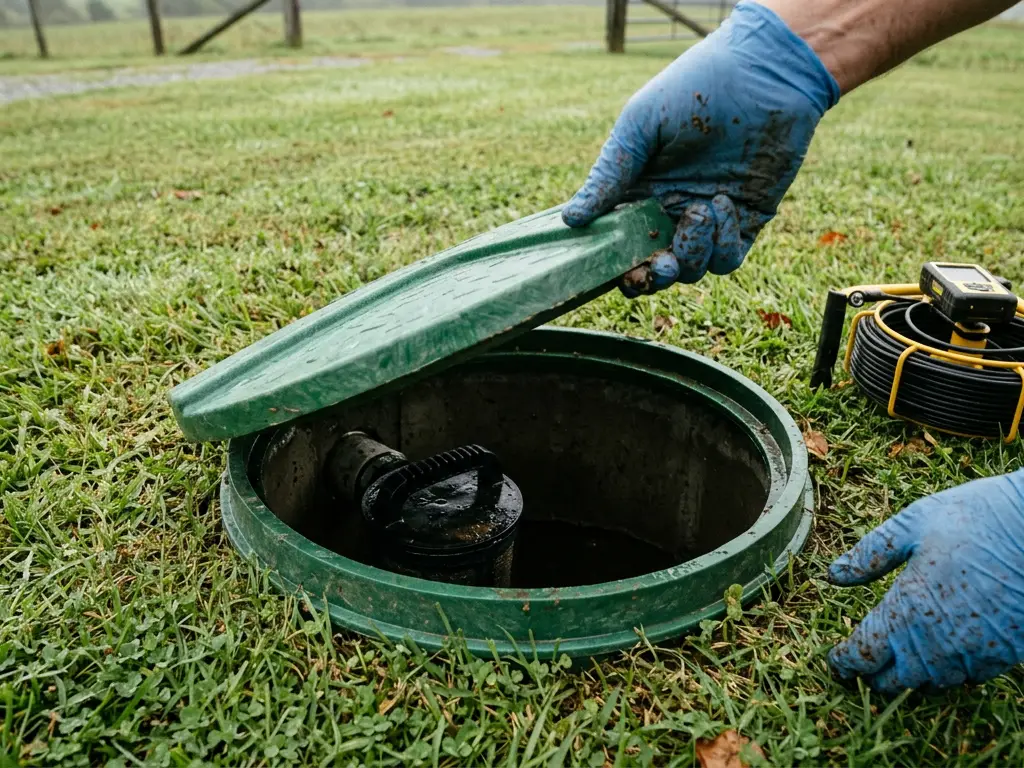
Septic Pumping vs Septic Cleaning: What You Are Actually Paying For
Septic pumping and septic cleaning are different services. What each includes in Clarksville, TN, and how to tell which you need. Call to book.
Published by Clarksville Septic & Drainfield, serving Clarksville and Montgomery County, Tennessee. Questions about your own system? (931) 271-5114.
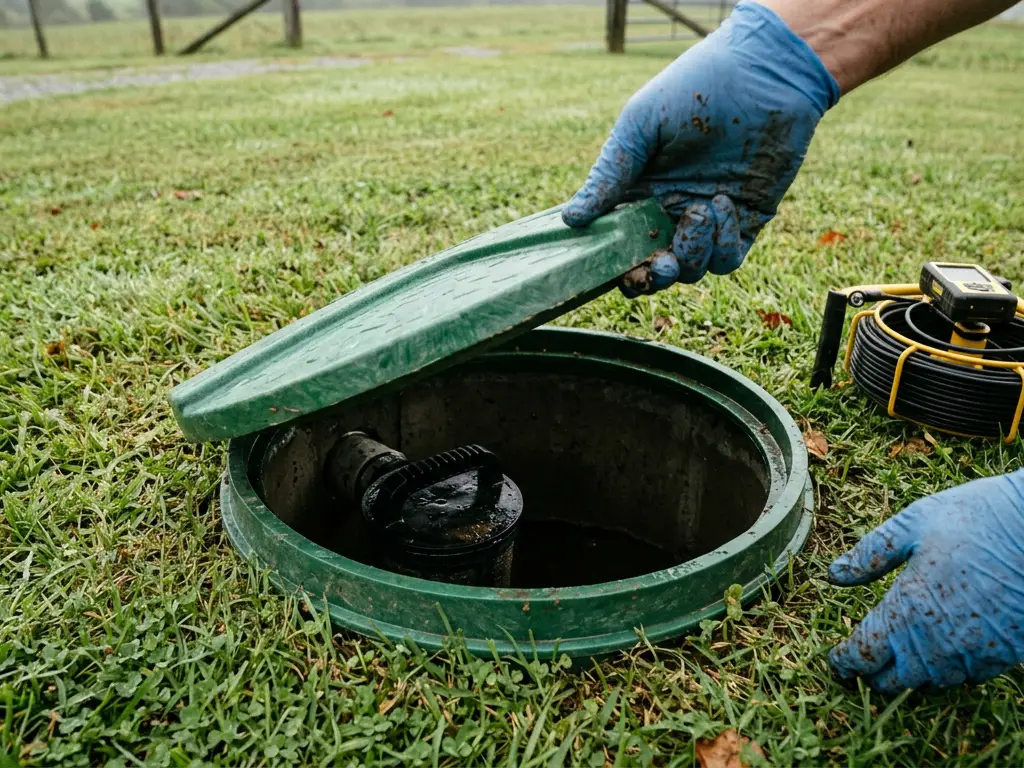
These two words get used interchangeably by homeowners and, often enough, by companies. They are not the same service, they do not cost the same, and on a neglected tank ordering the wrong one means paying for a job that was half done.
Here is the distinction, why it exists, and how to tell which one your tank needs.
Pumping
Pumping is vacuum work. A truck arrives, a hose goes into the tank, and the liquid plus whatever sludge will move gets drawn off and hauled to an approved disposal site.
It is the routine service, it is what most households need every three to five years, and it runs $375 to $700 for a standard 1,000 gallon residential tank around Clarksville.
The key limitation is in the word vacuum. A hose lifts what will flow. On a tank in normal service that is nearly everything, because the sludge layer is still soft and mobile.
Cleaning
Cleaning is pumping plus mechanical work. The interior walls get washed down, hardened material on the floor and on the baffles gets broken loose with water pressure and agitation, and the tank is left close to how it went into the ground.
It takes longer, it removes considerably more material, and it runs $475 to $1,300 depending on how compacted things are.
A tank that has gone a decade can be two thirds full of material a vacuum hose will not lift. You can pay for a pump-out on that tank and drive away with most of the problem still in the ground.
Why the difference matters more here than in some places
Sludge is not uniform. Over years it compacts under its own weight into something closer to wet concrete than to liquid, and once it reaches that state a hose passes over the top of it.
Local soil makes this worse. Montgomery County sits on the Highland Rim, and the silty clay loam here means household wash water carries more fine clay than it would in a sandy region. Those fines settle into the sludge layer and make it denser and more cohesive than sludge elsewhere.
The practical result is that tanks in this county that have gone eight or ten years genuinely need cleaning rather than pumping, and a straight pump-out on one will disappoint. This is not upselling, it is what the material does.
How to tell which one you need
Pumping is enough if
- You are on a normal three to five year cycle
- The tank has service history and nothing unusual is happening
- Drains are normal and you are servicing on schedule rather than in response to a problem
Cleaning is the right call if
- It has been eight years or more, or nobody knows
- You bought the property and no records came with it
- A previous crew said the tank would not fully empty
- Drains are still slow shortly after a pump-out
- There is visible crust or black staining at the outlet when the lid is off
That fourth one is the most common way people discover they needed cleaning: they pump, nothing improves, and they assume the drainfield has failed. Sometimes it has. Often the tank is still substantially full.
What neither one fixes
Neither service repairs a drainfield. If soil pores in the field have plugged with solids, removing everything from the tank stops it getting worse and does not reverse what has happened.
This is worth being clear about because it is where money gets wasted in both directions. People order drainfield work when their tank simply needed cleaning, and people order repeated cleanings on a field that is finished.
The test is the liquid level. If the tank was emptied and the level is back above the outlet within days on normal household use, the field is not accepting water and that is a separate problem.
Terms you will also hear
- Clean out is generally used to mean cleaning, though some companies use it loosely for pumping. Ask what is included.
- Evacuation usually just means pumping.
- Back-flushing is part of cleaning: liquid is returned under pressure to break up the solid layer before it is removed.
- Aeration or hydro-jetting in a septic context normally refers to drainfield line work rather than tank service.
If a quote uses one of these words, ask a plain question: will the walls be washed down and hardened material removed, or is this a vacuum job. That single question resolves almost all of the ambiguity.
What to ask before booking
- Is this pumping or cleaning, and what specifically is included?
- Is lid excavation included if the lid turns out to be buried?
- Will the effluent filter be cleaned while the tank is open?
- Will you tell me the liquid level before you start pumping?
That last one is the most useful question on the list and almost nobody asks it. The level relative to the outlet before the tank is emptied is the single best piece of free diagnostic information available about your drainfield, and once the truck starts it is gone. A crew that volunteers it is paying attention.
The honest summary
Most people, most of the time, need pumping. Cleaning is for neglected tanks, unknown systems and the situation where a pump-out did not fix what it should have.
If you are unsure which category you are in, the answer is usually the date of the last service, and the fact that nobody knows it is itself the answer. Properties across the parts of the county we cover vary enormously here: newer systems in the Sango corridor are mostly on a sensible cycle, while the older stock out toward Palmyra and Indian Mound frequently has not been opened in over a decade.
Questions about your own system? Talk it through on the phone.
Call (931) 271-5114Questions people ask about this
What is the difference between septic pumping and cleaning?
Pumping vacuums out the liquid and whatever sludge will flow. Cleaning adds a wash-down of the interior walls and mechanical removal of hardened material from the floor and baffles. Cleaning takes longer and costs more, and it is the right call on a tank that has gone many years.
How do I know if I need cleaning instead of pumping?
If it has been eight years or more, if nobody knows the last service date, if a previous crew said the tank would not fully empty, or if drains are still slow shortly after a pump-out. On a normal three to five year cycle, pumping is enough.
Why did my drains stay slow after I had the tank pumped?
Two common reasons. A hardened sludge layer the vacuum could not lift, which needs cleaning. Or a fouled effluent filter choking flow out of the tank regardless of how empty it is. Both are cheaper to check than a drainfield.
Does cleaning kill the bacteria in my tank?
Not meaningfully. The bacterial population re-establishes within days from ordinary household wastewater. There is no need to buy an additive to restart it.
Need this done rather than explained?
Septic Tank Cleaning in Clarksville, with a written price before anyone starts work.