
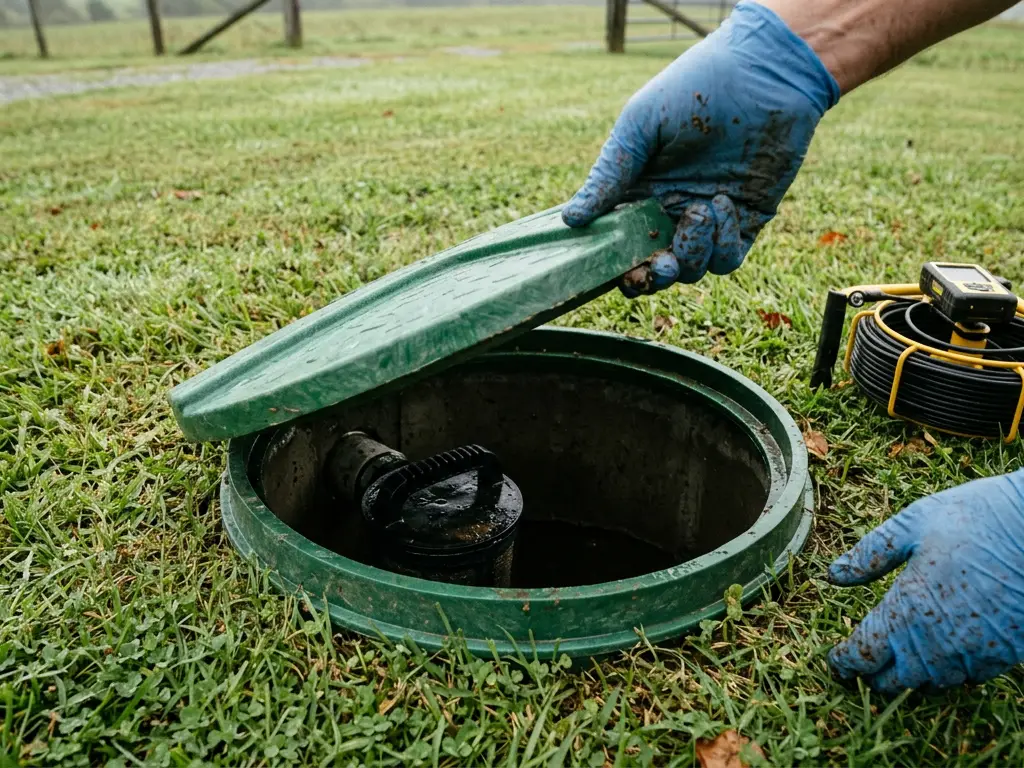
How Often a Septic Tank Actually Needs Pumping
How often a septic tank needs pumping in Clarksville, TN, and why three to five years is often wrong. Call to get your interval measured.
Published by Clarksville Septic & Drainfield, serving Clarksville and Montgomery County, Tennessee. Questions about your own system? (931) 271-5114.
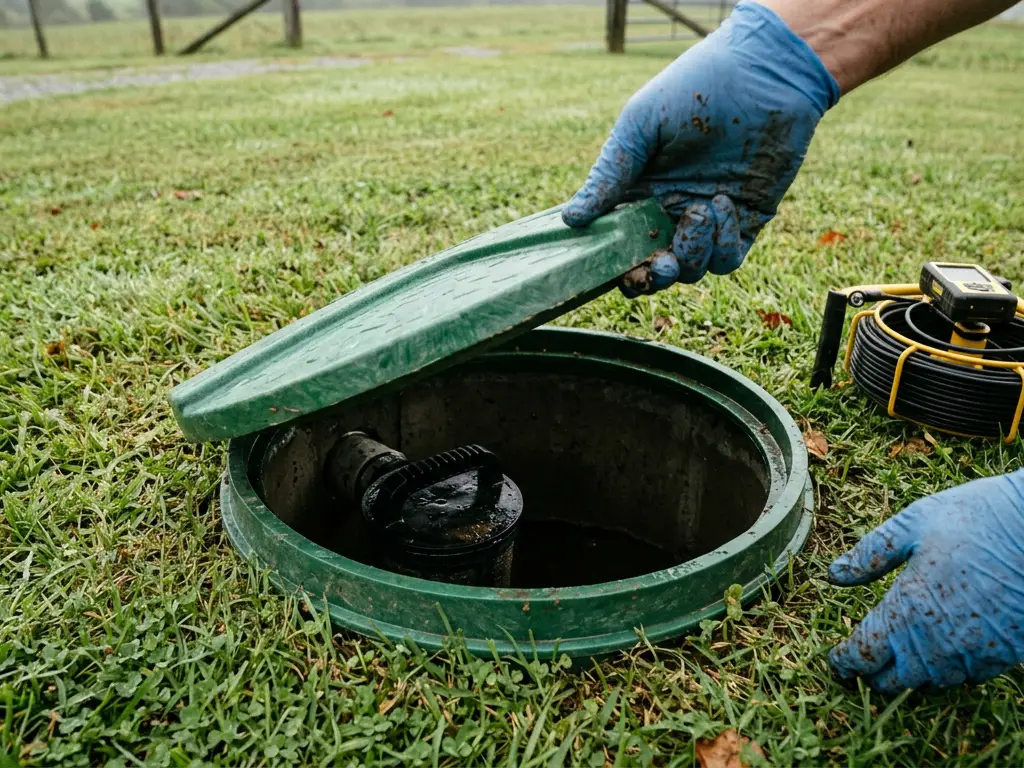
The standard answer is every three to five years. It is a reasonable starting point and it is wrong for a lot of households, in both directions. Some tanks need it every two years. Some genuinely go seven.
Here is what actually determines the interval, and how to find yours rather than guessing.
The two numbers that decide it
Pumping frequency comes down to a ratio: how fast solids accumulate against how much room the tank has.
Tank size is fixed and it is usually set by the number of bedrooms the house had when it was built. A 1,000 gallon tank is typical for three bedrooms, 1,250 to 1,500 for four or five.
Accumulation rate depends on how many people live there, what they put down the drain, and whether there is a garbage disposal.
A 1,500 gallon tank serving two people accumulates slowly. A 1,000 gallon tank serving six accumulates fast. Same rule of thumb, wildly different correct answers.
What pushes the interval shorter
A garbage disposal
The single biggest household variable. A disposal adds a large volume of fine organic solids that settle into the sludge layer and break down slowly. Regular use pushes a household toward two to three years rather than four or five.
More people than the house was designed for
A three bedroom house designed for a notional three or four occupants, occupied by six, is running the tank well past its intended load.
An undersized tank
Plenty of older Montgomery County systems were built with the smallest tank permitted at the time, and some predate meaningful permitting entirely. Out toward Palmyra, Cunningham and the Red River corridor, single-compartment tanks smaller than anything installed today are still in service.
Heavy laundry concentrated into one day
Six loads on a Saturday sends a surge through the tank that stirs settled solids and pushes them toward the outlet. Spreading it across the week genuinely helps.
What pushes it longer
- Fewer occupants than the design
- A larger tank than the household needs
- No garbage disposal
- Water-efficient fixtures throughout
A retired couple in a four bedroom house with a 1,500 gallon tank and no disposal can legitimately run six or seven years. The catch is that nobody should assume they are in this category without measuring.
The only way to actually know
Open the tank and measure the sludge depth. The working rule is that a tank wants pumping when solids occupy about a third of its depth, or when the top of the sludge layer comes within roughly a foot of the outlet.
That measurement takes minutes during any service visit and it converts a guess into a schedule. Have it measured once, note the date and the depth, and the next interval calculates itself.
Getting the interval right costs a few hundred dollars every few years. Getting it wrong costs a $9,000 to $18,000 drainfield.
Why the interval should be shorter here than the generic advice suggests
Montgomery County drainfields have less margin than the national rule of thumb assumes.
The silty clay loam over the Highland Rim accepts water slowly, and the perched water table that forms above the clay horizon through late winter and spring loads fields from below regardless of what the household does. A field already working near its limit in March is far less forgiving of solids arriving from a tank that is three quarters full.
The practical consequence: on clay, the tank is where you buy margin back. If you are deciding between four years and five in this county, take four.
Conditions vary across the areas we cover. Properties in the river bottoms toward the Cumberland and Red River see the sharpest seasonal loading; higher ground through Sango and the eastern county has more room to be relaxed about it.
Situations that need their own schedule
Rental property
The commonest failure pattern in this county, and it is concentrated around Fort Campbell where turnover is constant. Tenants rotate, nobody is told where the tank is, and the first anyone hears of it is a backup between tenancies. Rentals want a fixed calendar interval owned by the landlord, not by whoever happens to be living there.
Vacation or intermittently occupied property
Less use means slower accumulation, but long idle periods followed by heavy weekend use produce surges. Pump on a calendar rather than trying to estimate.
Anything with a pump or an aerobic treatment unit
These need attention between pump-outs: blowers, floats, filters and control panels fail on their own schedule. Set up proper maintenance rather than treating pumping as the whole job.
Commercial and multi-unit
Residential rules of thumb do not transfer at all. Many commercial systems need annual or twice-yearly service and some need quarterly.
What does not change the interval
No additive, enzyme, or tablet reduces how often a tank needs pumping. Products marketed on that promise do not do it, and some that emulsify solids make things worse by keeping material suspended so it leaves the tank instead of settling.
The bacteria a septic tank needs arrive continuously with ordinary household wastewater. There is nothing to add.
A workable rule
- Have the sludge depth measured at your next service and write down the date.
- If it was at a third of tank depth, that interval was about right. Repeat it.
- If it was well under, extend by a year and measure again.
- If it was at or above the outlet, shorten it and check the baffles while you are there.
- Revisit whenever the household changes: a new occupant, a new disposal, a finished basement with a bathroom.
Two measurements is all it takes to replace guesswork with a schedule that fits your actual system.
Questions about your own system? Talk it through on the phone.
Call (931) 271-5114Questions people ask about this
How often should a septic tank be pumped?
Every three to five years is the common starting point, but the right answer depends on tank size and household. A garbage disposal or more occupants than the house was designed for pushes it toward two to three years. A small household with a large tank can go longer.
How do I know when my tank is due?
Have the sludge depth measured during a service visit. The working rule is that a tank wants pumping when solids occupy about a third of its depth, or when the sludge comes within about a foot of the outlet. Two measurements give you a real schedule.
Does a garbage disposal really change how often I pump?
Yes, noticeably. It adds fine organic solids that settle into the sludge layer and break down slowly. A household using one regularly should expect to pump nearer three years than five.
Do septic additives reduce how often I need to pump?
No. Nothing you add removes sludge or replaces pumping, and products that emulsify solids can make matters worse by keeping material suspended so it leaves the tank rather than settling out.
Need this done rather than explained?
Septic System Maintenance in Clarksville, with a written price before anyone starts work.